
What is a Low-Tech Aquarium?
Definition and Fundamental Approach of the Low-Tech Aquarium
A low-tech aquarium is a setup approach that operates with low energy input in planted systems and prioritizes biological stability. A low-tech system is fundamentally a planted aquarium; the difference is that instead of accelerating plant growth, it aims to establish a sustainable balance within natural limits.
The concept of “energy input” here refers to the light intensity, CO₂ amount, and nutrient elements regularly added to the aquarium for plants. Installations where these three core parameters are kept controlled and at low levels are defined as low-tech. In other words, the system is intentionally operated with a limited light, limited carbon, and limited nutrient approach.
In this system, the goal is not maximum growth speed or intense pigment production in plants. The objective is to create a sustainable, balanced, and long-term stable ecosystem within natural limits. Since energy input is kept controlled, system parameters are more gently interconnected. Light, carbon, and nutrients are not aggressively increased; metabolic drive is intentionally limited. Thus, the balance between demand and supply is easier to maintain.
While growth rate and photosynthetic performance are deliberately pushed to higher levels in hi-tech systems, growth rate is naturally limited in the low-tech approach. This limitation makes the system more forgiving. Sudden parameter changes generally do not create dramatic biological breakdowns. Algae risk progresses in a more controlled manner due to the low energy input.
As a result, low-tech setups aim not for maximum production, but for maximum stability. They offer a more predictable structure for users seeking long-term balance and wishing to minimize maintenance intervention.
Lighting and Photosynthetic Balance
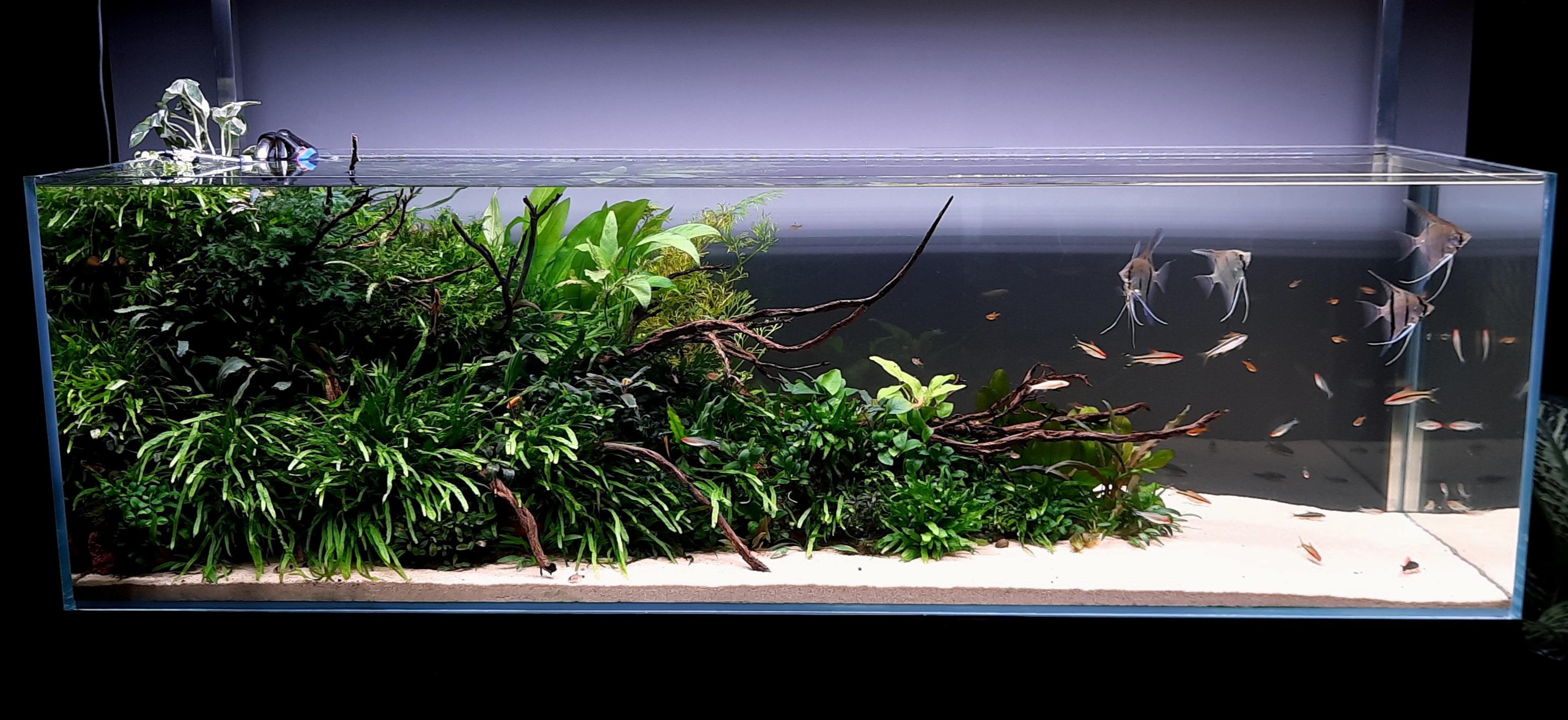
In low-tech systems, lighting is not at a level that forces photosynthetic capacity. It generally operates within a medium-low intensity range, and light intensity is adjusted so as not to exceed the naturally available carbon in the system. Because as light increases, the carbon demand of plants rises. If carbon supply remains constant, this imbalance creates conditions favorable to algae formation.
For this reason, in the low-tech approach, light is not a driving force of the system; it is a parameter that adapts to the system’s existing capacity. The photoperiod is mostly kept shorter, and a soft light character is preferred instead of abrupt transitions. On the spectrum side, balanced compositions close to natural appearance stand out. Excessive dominance of blue or red is generally avoided, as it requires high metabolic drive.
CO₂ Injection and Carbon Stability
In a low-tech aquarium, the primary source of CO₂ is atmospheric–water gas exchange occurring at the water surface. The current atmospheric CO₂ concentration is approximately 0.042% (≈420 ppm). At 25 °C, the amount of dissolved CO₂ in water equilibrated only with the atmosphere averages around 0.5–0.7 mg/L. This value indicates that the baseline carbon level achievable through passive gas exchange is quite low.
In addition to this equilibrium, fish respiration, bacterial activity, and organic matter decomposition also produce CO₂ in the aquarium environment. Thanks to these biological contributions, dissolved CO₂ in a typical low-tech tank containing fish generally ranges between 1–3 ppm during daytime hours. At night, as photosynthesis stops, CO₂ consumption decreases and values may temporarily rise to 3–8 ppm. However, this range depends on variables such as fish density, surface movement, water temperature, and carbonate buffering capacity (KH).
In hi-tech systems using pressurized CO₂ injection, the target level is mostly 20–30 ppm. This means approximately 10–50 times the carbon level naturally formed in a low-tech tank. Therefore, in low-tech systems, carbon is the determining and limiting factor. When light intensity exceeds this carbon capacity, plants cannot meet demand and the system becomes unstable.
As a result, the defining characteristic of a low-tech aquarium is a limited yet stable carbon cycle. When light, nutrients, and biological load are adjusted in harmony with this natural CO₂ capacity, the system operates in balance. When the carbon limit is pushed, photosynthetic imbalance and associated algae risk emerge.
Fertilization and Nutrient Management
In low-tech setups, the fertilization strategy progresses in a minimal and controlled manner. The goal in these systems is not to push plants to maximum growth speed, but to ensure stable development by preventing deficiencies. A nutrient-rich substrate is generally preferred, and liquid fertilizer support is applied in low doses. Since energy input is limited, nutrient addition must be compatible with this limitation.
Under low light and limited carbon conditions, plant nutrient consumption rates naturally decrease. Therefore, excessive macro or micro element loading may cause unused nutrients to accumulate in the water column. Over time, this accumulation may pose a risk, particularly in terms of algae formation. In the low-tech approach, the fertilization program should not be fixed and aggressive; it should be observation-based and measured. Dosage is adjusted based on plant form, leaf color, and growth rate.
Formulated in accordance with this balance principle, Creaqua Low-Tech Fertilizer is designed for aquariums containing slow-growing plants and operating with low support. With regular weekly use, it provides the necessary macro and micro nutrients in controlled ratios for healthy plant growth and development. The formula aims to eliminate deficiencies without causing excessive metabolic drive under low carbon and low light conditions.
In Creaqua Low-Tech fertilizer, macro elements are intentionally kept low. 0.09% Nitrogen (N), 0.01% Phosphorus (P), and 0.45% Potassium (K). In addition, 0.15% Calcium (Ca) and 0.10% Magnesium (Mg) support basic ionic balance. On the micro element side, Iron (Fe) is present at 0.2%, while Manganese, Zinc, Boron, Molybdenum, Cobalt, and Copper are formulated at trace element levels. This distribution is intended to meet the essential needs of plants without causing excessive nitrate or phosphate accumulation under low light.
As a result, fertilization in a low-tech aquarium is not performed to accelerate the system, but to establish a nutrient balance compatible with the existing energy input. Creaqua Low-Tech Fertilizer is positioned to support stable growth under low carbon and low light conditions in line with this approach.
Plant Selection and Morphological Outcomes
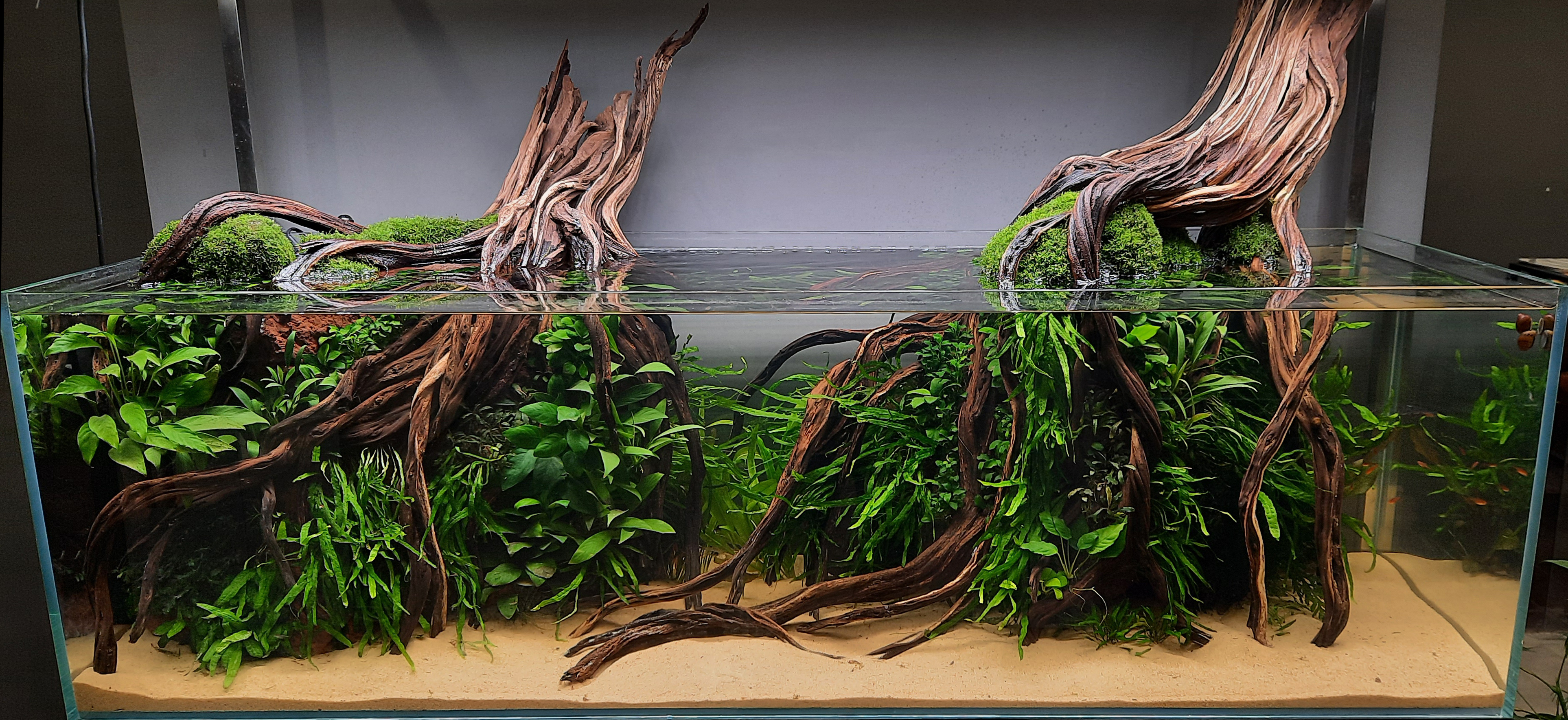
Plants preferred in low-tech systems are generally slow-growing species with low light tolerance and compatibility with carbon limitation. Anubias, Bucephalandra, Microsorum, Cryptocoryne, and various moss species are typical examples of this approach. These plants can maintain stable form in low-energy environments.
Morphologically, plants may exhibit a looser form compared to hi-tech systems. Internode distances may increase, and pigment intensity may be lower. However, this appearance is closer to natural biotope aesthetics. The goal of a low-tech system is not compact and dense production, but a calm and balanced visual composition.
Risks and Maintenance Requirements
Low-tech aquariums generally require less pruning, and sudden algae outbreaks are less common. The reason is that the system operates with low energy. As energy input increases, risk also increases; in low-tech setups, this threshold is intentionally kept low.
However, the slow operation of the system extends recovery time after intervention. When a parameter change is made, results are not seen immediately. For this reason, the low-tech approach requires patience. It may not be suitable for users expecting rapid transformation; however, it offers a stable structure in the long term.
Lighting Selection and Adjustment in a Low-Tech Aquarium
When selecting lighting in a low-tech setup, high lumen values or maximum watt power are not the primary criteria. What determines the choice is creating a measured photosynthetic intensity by considering the tank’s water height, plant species, and the system’s carbon capacity. Light level should not exceed the natural CO₂ limit and should not strain the system’s metabolic balance. In the low-tech approach, lighting is not a parameter increased to accelerate growth; it is a balance element adjusted to match the existing carbon and nutrient capacity.
The photoperiod is generally planned at a moderate duration, and soft transitions are preferred instead of abrupt on/off switching. The goal is not to create a dramatic visual effect, but to provide a stable biological environment. The more controlled the light character, the more predictably the system operates.
Within this framework, our brand’s lighting fixtures are designed to operate compatibly with low-tech aquariums. Especially the high-output ALPHA series can be precisely dimmed to the desired level and, thanks to its wide spectrum control, can be adapted not only to hi-tech setups but also to low-tech installations at different intensity levels and styles. Excess power is not a risk; when properly adjusted, it becomes an advantage of flexibility.
Click here for ALPHA RGBW preset settings for low-tech aquariums.
Only authorized members can post comments