
Low Tech Aquarium Lighting Preset Guide
Controlled Light Management in a Low-Tech Aquarium
In a low-tech aquarium system, lighting does not aim for maximum photosynthetic performance as in hi-tech setups. The objective is to ensure balanced plant growth within natural limits, maintain biological stability, and avoid exceeding the system’s carbon capacity. For this reason, in a low-tech approach, light is not a “driving force” but a stabilizing parameter.
In systems where CO₂ injection is limited or absent, light intensity, spectral composition, and photoperiod duration directly determine the risk of algae formation. When the balance between light, carbon, and nutrients is disrupted, the system becomes biologically fragile. Therefore, controlled light management in low-tech aquariums is less about producing high values and more about establishing the correct balance.
However, not every low-tech aquarium is the same. The spectral character must vary according to the setup style.
Blackwater
Blackwater systems are biotope setups that replicate naturally humic and tannin-rich waters. In these environments, the water column has an amber tone, and blue spectrum light is absorbed more rapidly. Photosynthetic intensity in the natural ecosystem is low.
Therefore, in the Blackwater style:
- High PPFD is not targeted.
- Cool white and heavily blue-weighted spectra are not preferred.
- A warmer character, lower intensity, and smoothly transitioned light composition is applied.
The goal is not to accelerate plants but to preserve the biotope aesthetic and low-energy ecosystem. Excessive blue and excessive intensity increase algae risk in systems with limited carbon capacity. In this style, the spectrum should support a natural shaded ambiance.
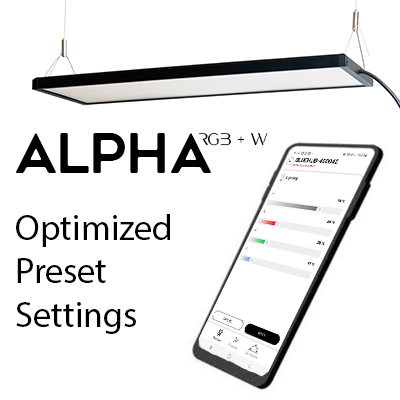
ALPHA RGBW - Blackwater Preset:
(R %26) (B %14) (B %0) (W %10)
Underwater measurement results at 34 cm distance:
PPFD @34 cm (µmol/m²/s): 34,62
CCT: 3900 K
CRI(Ra): 71
Epiphyte
In epiphyte-dominant setups (such as Anubias, Bucephalandra, and Microsorum), plants feed primarily through their leaves rather than roots and are adapted to shade conditions. In their natural habitats, they do not grow under direct sunlight but on tree trunks and rock surfaces under filtered light.
Therefore, in the Epiphyte style:
- A medium-to-low PPFD range is sufficient.
- Excessive red intensity is unnecessary.
- A balanced spectrum close to natural daylight is preferred.
High light in these plants may trigger stress and algae formation instead of compact growth. In epiphyte systems, the role of light is not to accelerate growth but to maintain healthy and stable morphology.
ALPHA RGBW - Blackwater Preset:
(R %3) (B %11) (B %5) (W %27)
Underwater measurement results at 34 cm distance:
PPFD @34 cm (µmol/m²/s): 49,17
CCT: 6900 K
CRI(Ra): 93
Natural
The Natural style references balanced plant compositions found in nature. It is neither as aggressive as a high-energy stem tank nor as limited as a strict biotope. The aim in these systems is to establish a balance between natural appearance and sustainable growth.
In this style:
- A moderate level of photosynthetic intensity is sufficient.
- The spectrum should have a neutral character.
- Excessive blue or overly warm tones are avoided.
In Natural systems, visual balance and biological balance progress in parallel. If the light is too aggressive, carbon limitation may cause the system to shift toward algae; if too low, plants may remain weak. Therefore, a controlled and measured spectral structure is required.
ALPHA RGBW - Blackwater Preset:
(R %5) (B %12) (B %5) (W %34)
Underwater measurement results at 34 cm distance:
PPFD @34 cm (µmol/m²/s): 58,52
CCT: 6575 K
CRI(Ra): 94
Riverbank
The Riverbank style imitates shoreline plants and semi-aquatic transition zones. In these environments, light is typically fragmented, fluctuating with surface reflections, and lower in intensity than direct tropical sunlight.
Therefore, in Riverbank systems:
- Soft-transition lighting is preferred.
- The spectrum is kept close to natural daylight.
- Harsh, high-contrast blue character is avoided.
In this style, the goal is not dramatic pigment production but the preservation of natural form and leaf texture. In Riverbank setups, light is a tool that emphasizes composition rather than a biological driving force.
ALPHA RGBW - Blackwater Preset:
(R %4) (B %18) (B %5) (W %36)
Underwater measurement results at 34 cm distance:
PPFD @34 cm (µmol/m²/s): 62,60
CCT: 6725 K
CRI(Ra): 91
Why Is Spectral Discipline Critical in Low-Tech?
The most common mistake in low-tech aquariums is taking hi-tech values as a reference. High PAR, high blue ratio, or long photoperiods create biological imbalance in systems with limited carbon capacity.
The same fixture can produce completely different results under different presets. Therefore:
- Light intensity must not exceed carbon capacity.
- Spectrum must be determined according to the setup style.
- Photoperiod should be planned with soft transitions.
In the low-tech approach, success is achieved not by reaching maximum values but by correctly interpreting the system’s limits. In this context, light is not a force that pushes growth but a parameter that preserves balance.
Only authorized members can post comments