
What Is a Hi-Tech Aquarium?
Definition and Fundamental Approach of a Hi-Tech Aquarium
A hi-tech aquarium is a setup approach within planted aquarium systems that deliberately aims to maximize photosynthetic performance, operates with high energy input, and therefore requires precise balancing of all parameters. The objective in this system is not merely plant survival; rather, rapid growth, compact form, intense pigment production, and controlled morphology are essential. For this reason, the hi-tech approach resembles a laboratory-controlled biological production environment more than the slow, low-energy dynamics of a natural pond. Light, carbon, and nutrients are intentionally increased, and plant metabolism is driven at an elevated level.
Lighting and Photosynthetic Drive
High light intensity forms the core of this system. High light is generally defined by PPFD values starting above 80 µmol/m²/s at substrate level and often reaching the 150–200 µmol/m²/s range. Light is important not only in terms of intensity but also spectral distribution; the red band supports photosynthetic drive and pigment production, the blue band influences compact growth and shorter internodes, while the white channel provides broad-spectrum balance, enhancing visual naturalness and penetration. When high light is used, photosystem activity within plant cells accelerates, creating greater carbon demand; therefore, pressurized CO₂ injection becomes mandatory in hi-tech systems.
To position this technical framework more clearly, PAR ranges must be evaluated categorically. The 20–40 µmol/m²/s range falls into the low light class, where photosynthetic drive is limited; shade-tolerant species such as Anubias, Cryptocoryne, Java Fern, and moss can develop stably at this level. The 40–90 µmol/m²/s range represents medium light and is generally considered sufficient for overall plant cultivation in many Nature-style or Iwagumi layouts. At this level, the system operates more stably and although CO₂ demand begins to increase, a margin of tolerance still exists.
The 90–150 µmol/m²/s range is where hi-tech characteristics become clearly pronounced. In this band, photosynthesis increases significantly; carpeting plants spread horizontally, pigment production intensifies in red-toned species, and trimming intervals shorten. However, at this level, carbon or nutrient deficiency can quickly turn into algae pressure. Values above 150 µmol/m²/s fall into the very high light category and are used in expert-level setups, dense compositions, or to create controlled sun-exposure effects on plants. In this range, the system does not tolerate error; CO₂ stability, circulation, and nutrient balance require millimetric precision.
Therefore, the PAR ranges presented in the table should be read not only as a classification of light intensity but also as a definition of the system’s metabolic speed and maintenance requirements. As light increases, not only does growth accelerate, but overall energy input rises, and carbon, macro, and microelement demand increases in a non-linear manner. The hi-tech approach truly gains meaning within these high PAR ranges, because light ceases to be a passive illumination element and becomes an active driving mechanism that accelerates biological production.
| PAR Range | Category | Application |
|---|---|---|
| 20-40 µmol/m²/s | Low Light | Anubias, Cryptocoryne, Java Fern, Moss |
| 40-90 µmol/m²/s | Medium Light | Iwagumi, Nature-style, general plant cultivation |
| 90-150 µmol/m²/s | High Light | Demanding plants, red tones, carpeting plants |
| 150+ µmol/m²/s | Very High Light | Expert level, dense compositions, sun exposure effect |
CO₂ Injection and Carbon Stability
CO₂ forms the biochemical backbone of a hi-tech aquarium. A stable carbon dioxide concentration, typically in the 20–30 ppm range, is targeted, and this stability is critical for preventing algae formation. Fluctuating CO₂ levels, especially under high light, create plant stress and provide suitable conditions for opportunistic algae species. Therefore, regulator quality, diffusion efficiency, and homogeneous in-tank circulation are determining factors in hi-tech systems. If carbon supply is insufficient, the energy provided by high light cannot be utilized biochemically, and system imbalance occurs.
Fertilization and Nutrient Management
In an aquarium operating at high PAR levels, photosynthesis increases significantly, and macro and micro nutrient consumption rises accordingly. As light increases, demand for nitrogen, phosphorus, and especially potassium also increases; therefore, balanced and regular dosing of macro elements is necessary in hi-tech systems. A balanced macro formula containing 1.6% nitrogen, 0.1% phosphorus, and 5% potassium reduces the risk of limiting factors under high light. Developed in line with this approach, Creaqua Macro provides safe and predictable macro support alongside increasing light intensity.
Microelements play a critical role in maintaining enzymatic processes under high photosynthetic activity. Balanced delivery of iron, manganese, zinc, boron, and other trace elements directly influences pigment stability, particularly in red-toned plants. A micro structure supported with calcium, magnesium, vitamins, and amino acids assists metabolic recovery during intense trimming and high light periods. In this context, Creaqua Micro is designed to ensure trace element continuity in tanks operating under high light.
In high-tech systems, potassium consumption often occurs faster than other macronutrients. Therefore, the ability to fine-tune with separate potassium supplementation when necessary is important. Containing 5% liquid potassium, Creaqua Potassium is used to support leaf integrity and photosynthetic regulation, especially under high PAR conditions.
As lighting increases, mineral balance becomes more critical. In RO-based systems, GH must be elevated; however, unnecessary increases in conductivity can cause osmotic stress in plants. Creaqua GH Plus, capable of providing approximately 5 dGH at around 100 µS/cm, supplies essential calcium and magnesium under high light conditions following a low ionic load principle.
In conclusion, in a hi-tech aquarium, light alone is not a performance factor; the elevated metabolic rate induced by light must be supported with balanced nutrients and minerals. The Creaqua Plant Nutrient Series offers a modular nutrition approach designed to maintain this balance in systems operating under high PAR.
Plant Selection and Morphological Outcomes
The hi-tech approach is particularly suitable for fast-growing species with high metabolic capacity and strong physiological response to light. Under high PAR levels, as photosynthetic flow accelerates, plants not only grow faster but also exhibit distinct morphological changes. Stem thickness increases, internode distance shortens, shoot density rises, and response to trimming accelerates. This provides a significant advantage for aquascapers in composition control, as form can be deliberately directed through light and nutrient balance.
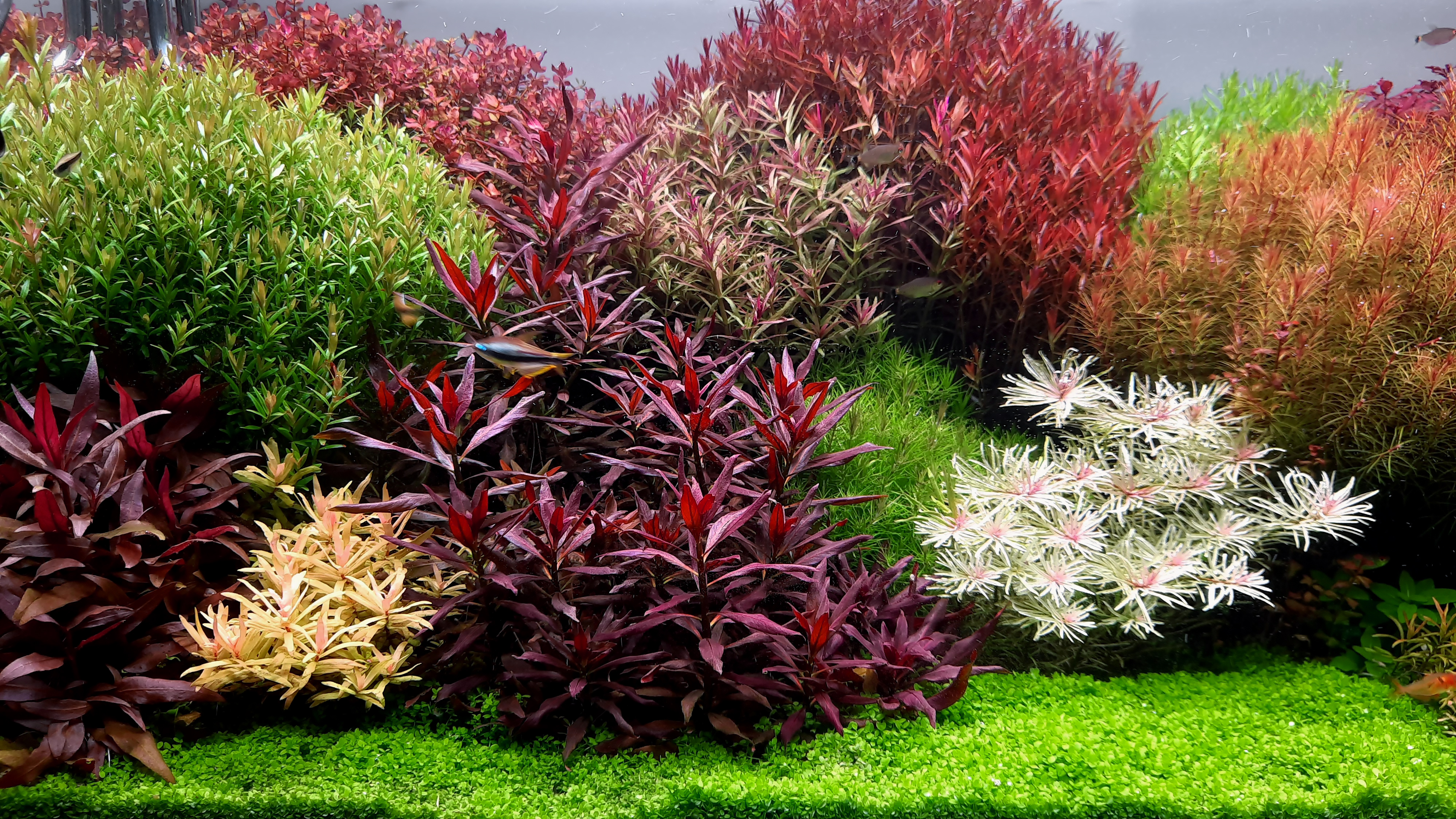
In species with red pigment potential such as Rotala, Ludwigia, and Alternanthera, high light functions as a stress factor that triggers anthocyanin synthesis. However, light alone is insufficient; stable CO₂ support and consistent microelement supply, particularly iron, are required. Under sufficient PAR, more intense red, orange, or purple tones are observed in upper shoots; under low light, the same plants exhibit greener and elongated forms. Thus, the hi-tech system optimizes pigmentation not only aesthetically but physiologically.
From the perspective of carpeting plants, species such as Hemianthus callitrichoides, Glossostigma elatinoides, or Micranthemum tweediei ‘Monte Carlo’ display horizontal growth tendencies under high light and adequate carbon. High light reduces vertical elongation demand, while sufficient CO₂ supports dense and compact shoot formation. This combination creates a uniform and dense carpet appearance. When light is insufficient, the same species grow upward, developing a sparse and weak structure.
Another morphological outcome observed in hi-tech systems is controllable leaf size. Under high light and balanced nutrition, many stem plants develop smaller but thicker leaves, strengthening scale perception within the composition. Additionally, post-trim side shoot proliferation occurs more rapidly, making it possible to create dense and voluminous plant masses. These characteristics support the depth, perspective, and volume effects sought in competition tanks.
For this reason, the majority of professional aquascape competition tanks operate under hi-tech principles. Rather than waiting for natural growth, this approach enables deliberate morphological control through light, carbon, and nutrient parameters. When properly implemented, a hi-tech system produces not only faster growth but controlled form, intense pigmentation, and high visual contrast.
Risks and Maintenance Requirements
The primary disadvantage of this system is its low error tolerance. Due to high energy input, minor imbalances can quickly escalate into algae outbreaks or plant melt. Therefore, regular trimming, water changes, and parameter monitoring are mandatory. Compared to low-energy systems, a hi-tech aquarium requires more intensive maintenance; in return, it delivers maximum visual performance and rapid results.
Lighting Selection and Adjustment in a Hi-Tech Aquarium
In a hi-tech aquarium, lighting is not merely one component of the system; it is the direct determinant of photosynthetic drive. However, the critical factor is not simply producing high PAR. Spectral distribution, channel balance, photon density, and fine adjustments according to aquarium style directly influence plant morphology, coloration, and growth rate. Since perceived brightness by the human eye differs from the light utilized by plants in photosynthesis, relying solely on visual assessment for adjustments often leads to misleading results.
In RGB+W systems, maximum power values alone are not meaningful; when channel distribution changes, both spectral character and biological output change accordingly. Therefore, as important as selecting the light itself is creating the correct preset and interpreting measurement data within a spectral context.
You can find our comprehensive article here, which details lighting selection in high-tech aquariums, PAR interpretation, spectrum analysis, and preset setups optimized for aquarium style.
Click here for the High Tech Aquarium Lighting Preset Guide.
Only authorized members can post comments