
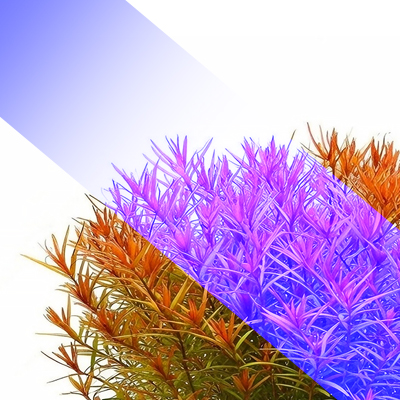
The Effect of Colors on Plants in RGBW Lighting – BLUE
The Impact of Independent Channel Control in RGBW Aquarium Lighting on Planted Aquariums – Blue Channel
In our previous articles, we covered the red channel’s effects on growth rate and coloration, and the green channel’s role in under-leaf penetration and in-tissue light distribution. The blue channel, the third and most critical component of the RGB spectrum, is the primary factor that determines a plant’s growth pattern, form, and morphological structure.
Beyond being a powerful energy source for photosynthesis, blue light is a spectral signal that governs a plant’s developmental decisions. Leaf thickness, internode distance, compact growth, shoot structure, upright posture, and phototropic behavior largely depend on the intensity of blue wavelengths.
In an aquarium environment, the blue channel’s effect is not limited to surface-level photosynthesis. The way water refracts and diffuses light changes how blue wavelengths are perceived by the plant. For this reason, the blue channel determines not how fast the plant will grow, but what form it will grow into.
In this article, we will examine the effects of the blue channel on plants in RGBW lighting through low and high usage scenarios.
We are again leaving the white channel for last; because without properly understanding the blue component of the RGB channels, the true role of white light on plants cannot be interpreted correctly.
An In-Depth Analysis of the Blue Channel in RGBW Aquarium Lighting
While red light gives the plant energy, blue light gives the plant shape.
Although the blue channel contributes to photosynthesis, it shows its main effect on plant morphology, leaf thickness, internode distance, and pigment activation.
Many hobbyists associate blue light only with a “cool look.” However, blue light is the most critical signal governing how a plant perceives the sun.
1. Blue LED Quality and Band Range
The blue band plants use most efficiently:
440 nm – 470 nm
Within this range, there are two important regions:
| Band | Wavelength | Effect |
|---|---|---|
| Deep Blue | 440–455 nm | Chlorophyll-B absorption, pigment triggering |
| Royal Blue | 455–470 nm | Morphological control, compact growth |
Most low-cost blue LEDs on the market are typically close to 470 nm. They look bright visually, but their botanical effect is weak.
High-quality fixtures include strong intensity in the 445–455 nm range. This band creates the strongest morphological effect in plants.
2. The Relationship Between Blue Light and PAR
Blue light contributes to PAR, but it is not as “energy-providing” as red.
Nevertheless, PAR readings increase as blue increases because:
- Chlorophyll-B peak absorption: ~453 nm
- Chlorophyll-A secondary absorption: ~430 nm
When the blue channel is increased:
- The plant perceives more light
- Photosynthetic efficiency is balanced
- Excessive elongation caused by red is suppressed
3. Physiological Processes Triggered by Blue Light in Plants
As blue light increases, the following changes are observed in plants:
- Internode distance shortens
- Leaf thickness increases
- Leaf surface area expands
- The stem becomes sturdier
- The plant shifts toward horizontal growth
- Pigment production (including anthocyanins) is triggered
Blue light sends the plant this message:
For this reason, blue light balances the vertical growth promoted by red.
4. If the Blue Channel Is Kept Low
- The plant elongates upward rapidly
- Spacing between leaves opens up
- Leaves become thinner
- Red plants fail to color up
- The plant looks weak and loose
This is especially noticeable in stem plants such as Rotala, Ludwigia, and Hygrophila.
A common hobbyist mistake:
Increasing red while keeping blue low.
Result: Fast growth, but poor form.
5. If the Blue Channel Is Kept High
- Compact, dense form
- Thick, healthy leaves
- More intense pigmentation
- More controlled growth
- Less frequent trimming needed
However, excessive blue:
- May slow down the growth rate
- May make the aquarium look visually colder and harsher
6. The Relationship Between Blue Light and Anthocyanins
Anthocyanin production is not driven by red alone.
Blue light is the trigger that activates this pigment production.
Red light provides the energy,
Blue light initiates pigment production.
Therefore, in red plants:
- High red + low blue = Brownish, dull tones
- High red + high blue = Vivid, bright red
7. Blue Light and Nutrient Uptake
As blue light increases:
- Cell walls thicken
- Leaf surface area expands
- The plant consumes more micronutrients
In particular, increased demands include:
| Nutrient | Why |
|---|---|
| Magnesium (Mg) | Chlorophyll structure and light utilization |
| Iron (Fe) | Pigment and enzyme activity |
| Potassium (K) | Cell transport and resilience |
| Micronutrients | Enzymatic processes |
As blue light increases, micronutrient deficiencies become visible more quickly.
8. Blue Light and Algae
Blue light alone does not trigger algae.
In fact, when used in the right balance, it can reduce algae risk because:
- It strengthens plant form
- It enables plants to use light more efficiently
- It balances the uncontrolled energy surplus created by red
Conclusion
The blue channel is not a “color balance” setting.
The blue channel:
- Defines the plant’s shape
- Improves leaf quality
- Triggers pigment production
- Balances the effect of red light
- Increases micronutrient consumption
In RGBW systems, adjusting the blue channel is, in fact:
Adjusting how the plant will look.
Only authorized members can post comments