
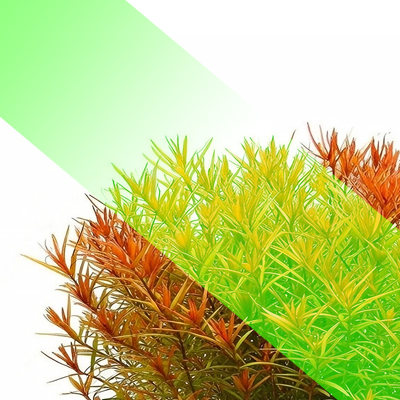
The Effect of Colors on Plants in RGBW Lighting – GREEN
The Impact of Independent Channel Control in RGBW Aquarium Lighting on Planted Aquariums – Green Channel
In our previous article, we examined the effect of the red channel on growth rate and coloration. In this article, we will focus on the green channel, which many hobbyists assume exists only for visual purposes, yet plays an extremely critical role in plant physiology.
Although green light appears to be the least absorbed wavelength by plants, in an aquarium environment it has a unique effect in terms of under-leaf penetration, lower-layer photosynthesis, and the distribution of light within plant tissue. The channel that nourishes not only the upper surface of the plant but also its internal structure and lower layers is green.
In this article, we will examine the effects of the green channel in RGBW lighting on plants through low and high usage scenarios. We will again leave the white channel for the end, because without properly understanding the green component of RGB, the true role of white light on plants cannot be correctly interpreted.
In-Depth Analysis of the Green Channel in RGBW Aquarium Lighting
Green light is the most misunderstood channel in RGBW lighting. For many years, the statement “plants do not use green light, they reflect it” has been passed on in an incomplete and misleading way. The reality is this: while part of the green light is reflected from the surface, a significant portion passes through the leaf and reaches lower tissues and lower leaves. This property makes green light the main component of volumetric illumination and deep penetration.
1. Green LED Quality and Band Range
From a botanical perspective, the effective green band lies between 520–560 nm. However, not every range within this band has the same effect.
| Band | Wavelength | Effect |
|---|---|---|
| Cyan-green | 500–520 nm | High progression in water, deep penetration |
| Pure green | 520–540 nm | In-leaf penetration |
| Yellowish green | 540–560 nm | Increased visual brightness, reduced botanical contribution |
Low-cost green LEDs on the market are typically around 550–560 nm. This range appears bright to the eye but has low botanical effectiveness. High-quality systems concentrate in the 520–535 nm range.
2. The Relationship Between Green Light and PAR
In PAR measurements, the contribution of green light does not appear as high as red and blue. For this reason, many people assume green is insignificant. However, PAR sensors cannot measure in-leaf and lower-leaf effects. Green light passes through upper leaves, reaches lower leaves, and penetrates into inner stem tissues. Therefore, green light has an effect that cannot be fully measured but can clearly be observed.
3. Physiological Processes Triggered by Green Light
- Lower leaves participate in photosynthesis
- The plant remains healthy from the base upward
- A bushy growth form develops
- Leaf loss in lower sections decreases
- Light distributes more uniformly throughout the aquarium
This effect is especially noticeable in frequently trimmed stem plants, densely planted aquariums, background plants, and shaded areas.
4. When the Green Channel Is Low
- Upper leaves remain healthy while lower leaves weaken
- Yellowing begins in lower sections
- Lower leaf drop occurs
- The plant appears dense on top and bare underneath
- A “tree-like” stem appearance forms
One of the major reasons hobbyists encounter lower leaf deterioration is insufficient green channel intensity.
5. When the Green Channel Is High
- The plant looks full from the bottom upward
- Light distributes evenly throughout the tank
- Shadowing decreases
- After trimming, lower sections recover quickly
- Stem plants develop a bushy form
6. Green Light and Nutrient Consumption
As green light increases, lower leaves become active, increasing the total photosynthetic surface and causing the plant to consume more overall nutrients. However, it does not increase specific micronutrient needs like red and blue do.
| Nutrient | Reason |
|---|---|
| Nitrate (NO₃) | Increased total photosynthetic surface |
| Potassium (K) | Cell transport |
| Magnesium (Mg) | Chlorophyll continuity |
7. Green Light and Visual Perception
The visual effect of the green channel is significant: the aquarium appears brighter and clearer, colors are perceived more naturally, and the harshness of RGB softens. This is not only aesthetic; it is also an indicator that light is distributing more effectively within the tank.
8. Green Light and Algae Relationship
Green light is not a band that triggers algae growth. On the contrary, by promoting uniform light distribution, it reduces shaded and weak areas, thereby lowering algae risk.
Conclusion
- Provides deep penetration
- Protects lower leaf health
- Creates a bushy plant form
- Distributes light uniformly throughout the tank
- Increases total photosynthetic area
In RGBW systems, adjusting the green channel is essentially the adjustment that keeps the plant healthy not only from the top but also from the base.
Only authorized members can post comments