
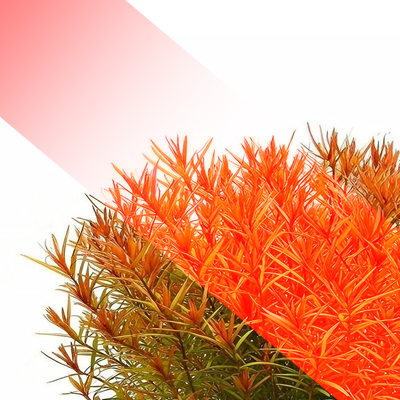
RGBW Lighting: The Impact of Colors on Plants – RED
The Effects of the Red Channel in RGBW Aquarium Lighting on Planted Aquariums - Red Channel
For many years, planted aquarium lighting was used as “single-spectrum” systems or, at most, two-channel (white + red/blue-supported) systems. Light intensity could be adjusted, but the character of the spectrum could not be managed by the hobbyist.
With RGBW systems, this situation changed fundamentally. It is no longer only “how much light you provide,” but how much of each light you provide that directly determines the plant’s form, color, leaf structure, internode distance, photosynthesis rate, and even its tendency toward algae formation.
In this article, we will examine the effect of the red channel in RGBW lighting on plants through low and high usage scenarios. Because correctly understanding red light is the foundation for establishing the right light–fertilizer–CO₂ balance in a planted aquarium.
1. Red Light (Red – ~620–660 nm)
An In-Depth Analysis of the Red Channel in RGBW Aquarium Lighting
Red light is the energy engine of planted aquarium lighting. However, for most hobbyists, the red channel is still perceived as “the light that gives color.” In reality, red light:
- Is the primary driver of photosynthesis
- Determines the plant’s stem and leaf thickness
- Triggers pigment production
- Changes the rate of nutrient consumption
- Directly increases CO₂ and fertilizer demand
- Increases algae risk when used incorrectly
Therefore, the red channel is not merely a visual adjustment, but a chemical and physiological control mechanism.
1. Why Is Red LED Quality Critical?
Not all red LEDs are the same.
The red band range that plants use most efficiently:
is 620 nm – 670 nm.
However, within this range there are two critical peaks:
| Band | Wavelength | Effect |
|---|---|---|
| Orange-leaning red | 620–630 nm | High visual brightness, lower photosynthesis efficiency |
| Deep red (Deep Red) | 650–665 nm | Maximum chlorophyll absorption, the true photosynthesis band |
Most low-cost red LEDs on the market are typically around 620–630 nm. The aquarium looks bright, but the plant cannot benefit sufficiently from it.
Deep red LEDs used in high-quality RGBW systems at 650–660 nm increase PAR dramatically.
Between two fixtures with the same lumen value, the one using deep red will have a much higher PAR value.
2. The Relationship Between Red Light and PAR
PAR (Photosynthetically Active Radiation) refers to the amount of light that the plant can use.
Red light is the color that provides the highest contribution in PAR measurements because:
- Chlorophyll-A peak absorption point: ~662 nm
- Chlorophyll-B peak absorption point: ~642 nm
Therefore, when the red channel is increased:
- PAR rises rapidly
- The plant produces more energy
- Metabolism accelerates
The result of this is:
When you increase red light, you are effectively providing “stronger light” to the aquarium.
3. Physiological Processes Triggered by Red Light in the Plant
When red light increases, the following changes begin in the plant:
- The rate of photosynthesis increases
- Sugar production increases
- The cell wall thickens (firmer leaves)
- Stem diameter increases
- The spaces between leaves shorten
- Pigment production is triggered (anthocyanin)
However, the critical threshold here is:
For these processes to continue, the plant’s consumption of nitrogen, iron, magnesium, potassium, and CO₂ increases.
If nutrients are not increased:
- The plant starts fast, then stops
- Deformation begins at the tips
- Algae appears
This situation usually creates the following perception among hobbyists:
“I increased the light, algae appeared.”
What actually happened:
Red light revealed a fertilizer deficiency.
4. Red Light and Anthocyanin (Red Pigment) Production
Red plants stay red not because of light, but because of the balance of light + nutrients.
Anthocyanin production increases under the following conditions:
- High red + sufficient blue
- High light stress
- Low but balanced nitrate
- High access to iron and micro elements
Fertilizer adjustment for anthocyanin
| Nutrient | Should it be increased? | Why |
|---|---|---|
| Iron (Fe) | Yes | Critical for pigment synthesis |
| Micro elements (Mn, Zn, Cu) | Yes | Enzymatic reactions |
| Magnesium (Mg) | Yes | Chlorophyll and energy production |
| Potassium (K) | Yes | Cell transport and metabolism |
| Nitrate (NO₃) | Should be reduced slightly | Excess nitrogen increases green growth and suppresses red |
| Phosphate (PO₄) | Should be kept balanced | Energy transfer |
Why do red plants turn green in high-nitrate water?
Because the plant is not under “stress” and does not need to produce pigment.
The red color is actually the plant’s defensive response to light stress.
5. Why Should CO₂ Be Increased If the Red Channel Is High?
Because red light accelerates photosynthesis, the plant consumes more CO₂.
If CO₂ is insufficient:
- The plant cannot use the energy
- Free energy is used by algae
- The risk of black beard algae and hair algae increases
Therefore, in aquariums with an increased red channel:
CO₂ should be supplied at a higher ppm and more stably compared to classic aquariums.
6. What Happens If Red Light Is Too High?
Red on its own and uncontrolled:
- Increases algae risk
- Plants grow extremely fast but weaken
- Form deteriorates
- Lower leaves drop
Therefore, red is never used strongly on its own.
It is balanced with blue and green.
Conclusion
The red channel is not just a “color adjustment.”
The red channel:
- Increases PAR
- Accelerates the plant’s metabolism
- Increases fertilizer consumption
- Increases CO₂ demand
- Triggers pigment production
- Determines the plant’s form and health
Therefore, in RGBW systems, red channel adjustment is also:
The adjustment of the fertilization and CO₂ strategy.
Only authorized members can post comments