
ALPHA RGBW Marine Setup and Simulation Guide
Reef Day Simulation Based on 34 cm Underwater Measurements
In reef aquariums, lighting is often evaluated according to fixture surface output values. However, what truly matters is the photon density reaching corals underwater. For this reason, all presets below are structured according to corrected PPFD and Lux measurements taken at 34 cm underwater depth. The objective is not to maximize raw light intensity, but to create a controlled energy curve that gradually increases and decreases biological load throughout the day.
34 cm Underwater Measurement Values
| Preset | R/G/B/W | PPFD (µmol/m²/s) | Lux | CCT | CRI |
|---|---|---|---|---|---|
| Reef Blue-Heavy Safe | 2 / 3 / 90 / 45 | 116.69 | 5749 | – | – |
| Reef Fluorescence VIEW | 1 / 3 / 100 / 9 | 70.51 | 2789 | – | – |
| Reef Growth (LPS/Anemone) | 3 / 4 / 85 / 85 | 164.66 | 9431 | 25458 K | 87 |
| Reef True Actinic | 0 / 0 / 85 / 5 | 56.69 | 1473 | – | – |
| Soft Reef DAY | 4 / 6 / 60 / 85 | 154.46 | 9437 | 12460 K | 91 |
These measurements represent the actual photosynthetic intensity reaching corals underwater, and the daily lighting simulation is structured according to these bands.
The day begins with Reef True Actinic. With a measured 56.69 µmol/m²/s PPFD, this preset activates the biological system without sudden photon spikes. Photosynthesis does not stop, yet metabolic load remains minimal. This phase protects pigmentation and ensures a smooth transition into higher daytime intensity.
The system then transitions into Reef Blue-Heavy Safe. At 116.69 µmol/m²/s, this range is considered safe for soft corals and sensitive LPS species. Photosynthesis becomes fully active while avoiding peak stress conditions. The blue spectrum remains dominant, with the white channel functioning as a controlled PAR carrier.
The backbone of the day is Soft Reef DAY. Producing 154.46 µmol/m²/s PPFD and 9437 Lux, this preset represents a stable reef daylight band. With a color temperature of 12460 K and a CRI of 91, it maintains tropical reef character while preserving color accuracy. This mode runs for the longest duration and establishes biological equilibrium.
The daily peak occurs with Reef Growth. Measured at 164.66 µmol/m²/s PPFD, this intensity supports LPS corals and anemones that demand higher energy. The 25458 K color temperature reflects strong blue dominance. This preset is intentionally limited in duration to prevent prolonged high-intensity stress.
In the evening, Reef Fluorescence VIEW is activated. At 70.51 µmol/m²/s PPFD, metabolic demand decreases while fluorescence proteins are strongly stimulated. This stage enhances visual impact without increasing biological load.
The day concludes again with Reef True Actinic. The lower intensity ensures a smooth sunset effect, and the final 30-minute ramp gradually reduces output to zero, maintaining biological rhythm.
12-Hour Lighting Schedule (30-Minute Ramp)
| Time | Preset | PPFD | Duration |
|---|---|---|---|
| 10:00 | Reef True Actinic | 56.69 | 1 hour |
| 11:00 | Reef Blue-Heavy Safe | 116.69 | 1 hour 30 minutes |
| 12:30 | Soft Reef DAY | 154.46 | 3 hours |
| 15:30 | Reef Growth (LPS/Anemone) | 164.66 | 1 hour 30 minutes |
| 17:00 | Soft Reef DAY | 154.46 | 2 hours 30 minutes |
| 19:30 | Reef Fluorescence VIEW | 70.51 | 1 hour |
| 20:30 | Reef True Actinic | 56.69 | 1 hour 30 minutes |
| 22:00 | OFF | – | – |
The BlueHub application displays this schedule as shown below. Preset transitions and 30-minute ramp periods can be clearly monitored within the timeline interface.
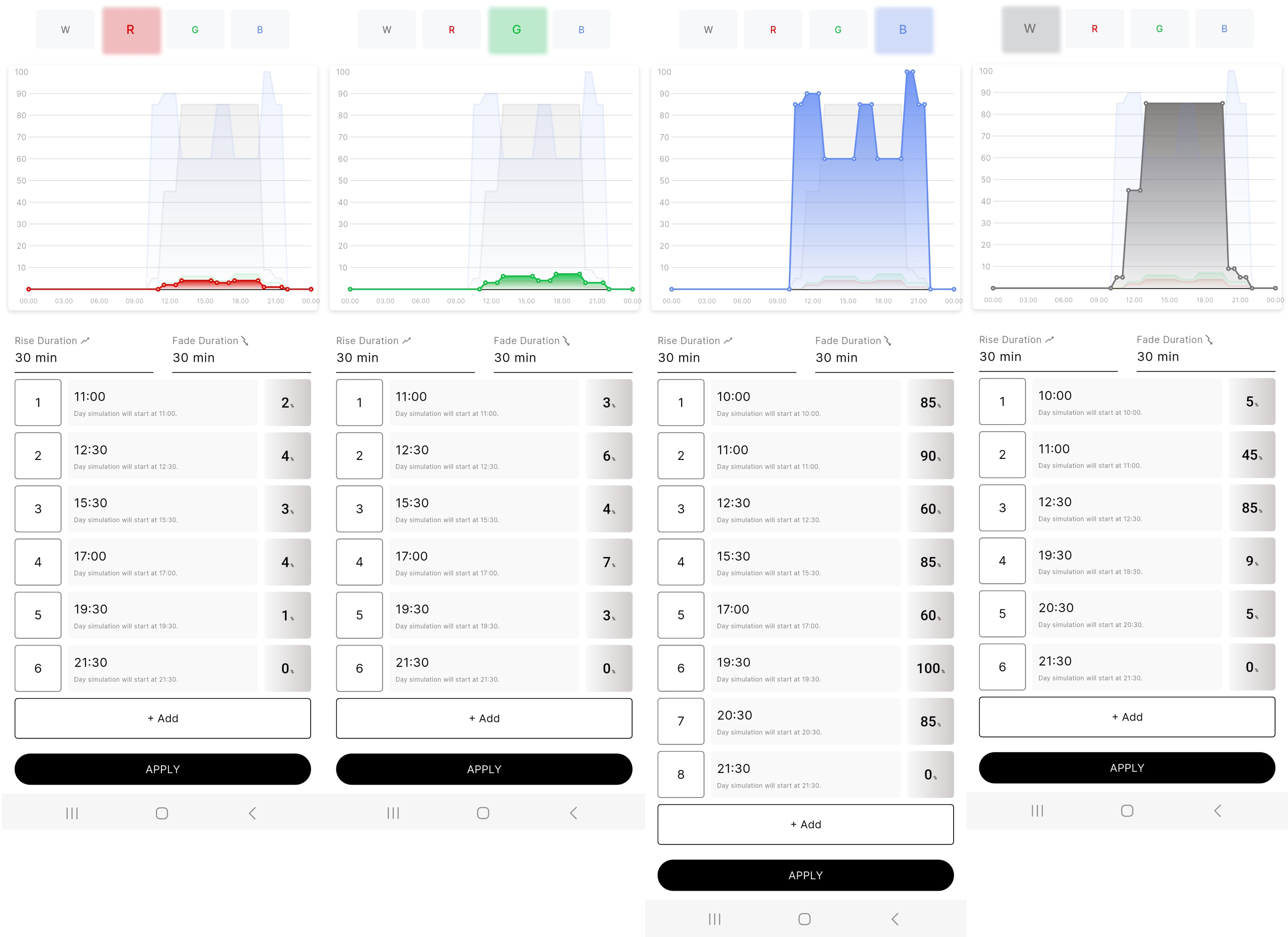
This distribution forms a bell-shaped energy curve throughout the day: low intensity in the morning, a controlled midday peak, a return to stability in the afternoon, and reduced metabolic load in the evening. By limiting exposure above 160 µmol while maintaining a stable 150 µmol daytime band, the system minimizes bleaching risk, preserves pigmentation, and supports long-term stability in soft coral and LPS-dominated reef aquariums.
Only authorized members can post comments