
High Tech Aquarium Lighting Preset Guide
Controlled Light Management in a Hi-Tech Aquarium
In a hi-tech aquarium system, lighting is not merely a piece of equipment; it is the center of the entire biological and visual balance. A properly selected and correctly configured lighting system plays a decisive role in the success of the setup. Plants’ photosynthetic capacity, coloration potential, internode distance, leaf morphology, and even the tendency for algae formation are directly related to the character of the light. Therefore, when lighting is chosen correctly and configured properly from a technical perspective, you have passed the most critical threshold for stable system operation.
Product Selection Is Not Enough: A Spectral Engineering Approach
In our previous article, we covered in detail the biological fundamentals of light, the concept of PAR, and the importance of spectral distribution. However, choosing the right product alone is not sufficient. How the light is applied to the aquarium, with which spectral composition, and at what intensity it is operated are at least as important as product selection. Because in hi-tech systems, light is not only “intensity”; it is a matter of controlled spectral engineering.
The Difference Between the Human Eye and Plant Physiology
Many hobbyists adjust lighting based on visual perception. If the aquarium looks bright and vivid to the eye, the setting is assumed to be correct. Yet the light perceived by the human eye is not the same as the light perceived by chlorophyll and accessory pigments in plants. The human eye is more sensitive around the green wavelengths near 555 nm. Plants, on the other hand, respond photosynthetically within the PAR band of 400–700 nm, especially in the blue and red regions. Therefore, a light that appears “sufficient” to the eye may be insufficient or unbalanced for the plant.
Spectral Requirements by Aquarium Style
For healthy and strong plant development, reaching a certain PAR level alone is not enough. Depending on the aquarium style (Dutch, Nature, Iwagumi, High-Energy Stem Tank, Biotope, etc.), the plant species used, and the CO₂ / fertilization regime, different spectral characteristics and different photon intensities are required. For example, in intensely red-pigmented species (Alternanthera, Rotala species), spectral composition and macro nutrient balance must be evaluated together. The same PAR value can produce different morphological outcomes under different spectral distributions.
Variable Technical Parameters in RGB+W Systems
Lighting manufacturers often share the technical data of their products at maximum power: maximum lumens, maximum PAR, maximum watts, and so on. However, in RGB or RGB+W systems, these values change dramatically when the channels are adjusted independently. When the percentage distribution of the red, green, blue, and white channels changes, not only the total light intensity changes; CCT, CRI, spectral energy distribution, and µmol/J efficiency also change. As a result, the same fixture can produce completely different biological responses in different presets.
The Problem of PAR Measurement and Interpretation
Some advanced hobbyists can use PAR meters. But interpreting the measured value correctly requires separate expertise. The measurement point (water surface, substrate, mid-water column), water height, glass transmittance, water clarity, diffuser structure, and spectral composition directly affect the result. Saying “this light is sufficient” or “too much” based on a single PAR value is often misleading. Because what matters is not only quantity but also quality: which wavelengths are provided in what proportion, and in which direction the plant’s physiological response is shaped.
From Theory to Practice: A Measurement-Supported Preset Approach
At this point, the spectral characteristics must be interpreted. However, full spectral analysis requires advanced measurement equipment (spectrometer, etc.), and most hobbyists cannot access such equipment. Therefore, the gap between theoretical knowledge and practical application grows. The light is either turned up more than necessary and the system is driven toward algae, or it is reduced too much and plant growth becomes weak.
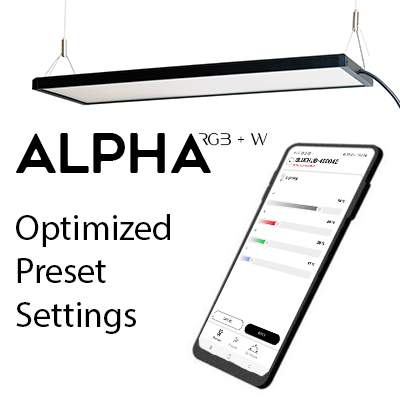
To simplify this problem for hobbyists and make it applicable, we carried out a systematic study. In Alpha RGB+W aquarium lighting, we created optimized preset values for different aquarium styles. These presets are not merely channel percentages; each is supported by real measurement data. PPFD (µmol/m²/s), lux, CCT, and CRI results were evaluated together, and a relationship was established between the spectral character and the biological target.
Introduction to ALPHA Series Measurement Data
First, let’s examine the data of the ALPHA series.
At this point, the theoretical framework must be supported by tangible measurement results. In the ALPHA RGB+W series, PPFD (µmol/m²/s), lux, CCT, and CRI values obtained under different preset combinations were evaluated together. When channel percentages were changed, it was clearly observed that not only the total light intensity but also the spectral character and biological effectiveness changed.
The purpose of this analysis is not merely to present “high numbers,” but to reveal which aquarium style and which biological target each preset is optimized for. The same fixture can produce completely different growth characteristics with different spectral compositions. Therefore, the data should not be read individually, but through the spectrum–biology relationship.
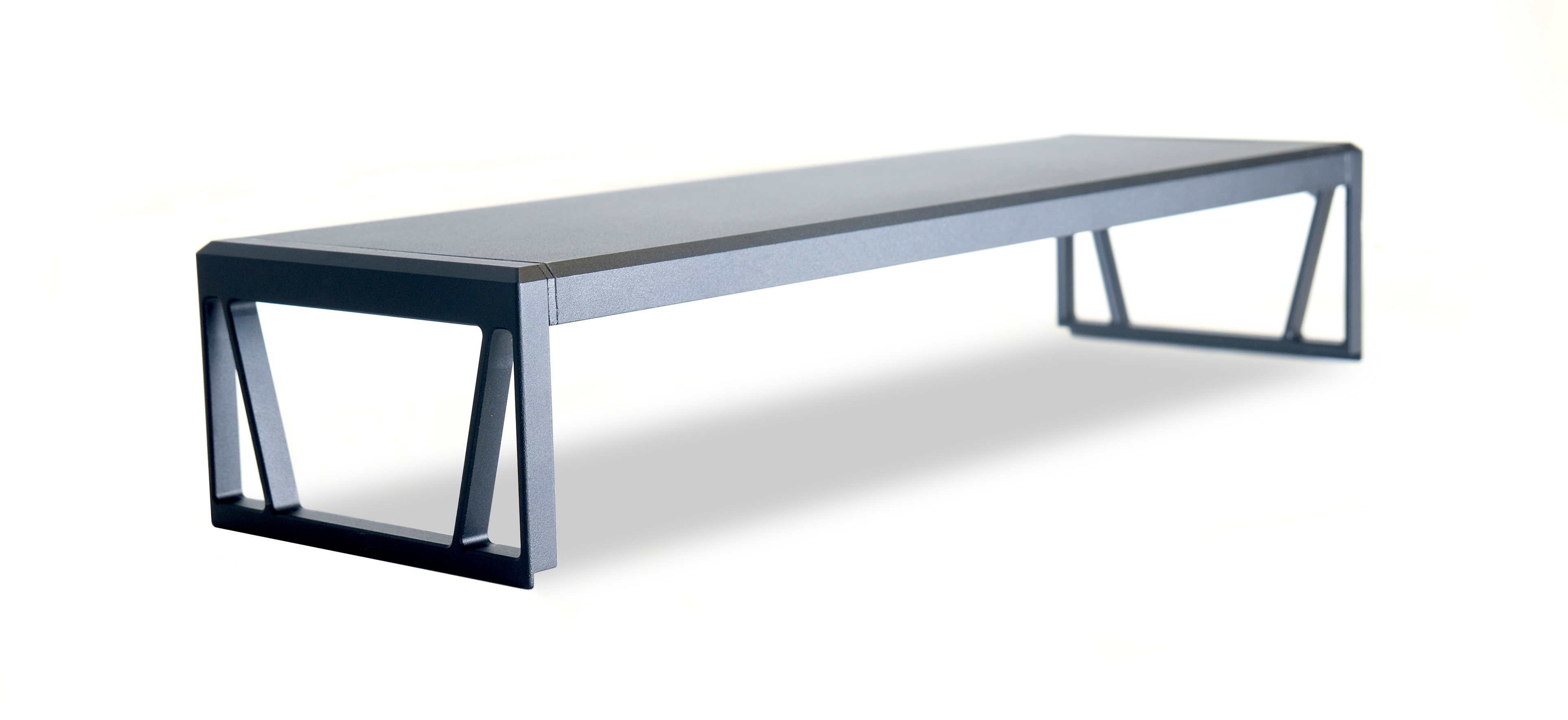
ALPHA RGB+W Series – Full Measurement Data
Below are the channel distributions of the presets created for the ALPHA series and the corresponding measurement results.
| Parameter | ALPHA 60 RGB+W | ALPHA 90 RGB+W | ALPHA 120 RGB+W | ALPHA 150 RGB+W |
|---|---|---|---|---|
| Model | ALPHA 60 RGB+W | ALPHA 90 RGB+W | ALPHA 120 RGB+W | ALPHA 150 RGB+W |
| Size | 60 cm | 90 cm | 120 cm | 150 cm |
| Power Consumption | 74W | 111W | 148W | 185W |
| Operating Voltage | 48V DC | 48V DC | 48V DC | 48V DC |
| LED Configuration | RGB + CRI 95+ White | RGB + CRI 95+ White | RGB + CRI 95+ White | RGB + CRI 95+ White |
| Control ( Bluetooth, iOS & Android App) |
4-channel independent dimming | 4-channel independent dimming | 4-channel independent dimming | 4-channel independent dimming |
| Average Beam Angle | Microprismatic 100° | Microprismatic 100° | Microprismatic 100° | Microprismatic 100° |
| Total Luminous Flux | 7452 lm | 11178 lm | 14904 lm | 18630 lm |
| Luminous Efficacy | 100.7 lm/W | 100.7 lm/W | 100.7 lm/W | 100.7 lm/W |
| Photosynthetic Efficiency (RGB) (Underwater at 34 cm depth) |
4.13 µmol/J | 4.13 µmol/J | 4.13 µmol/J | 4.13 µmol/J |
| Photosynthetic Efficiency (White) (Underwater at 34 cm depth) |
5.89 µmol/J | 5.89 µmol/J | 5.89 µmol/J | 5.89 µmol/J |
| Photosynthetic Efficiency (Total) (Underwater at 34 cm depth) |
3.48 µmol/J | 3.48 µmol/J | 3.48 µmol/J | 3.48 µmol/J |
| CCT (Infinitely adjustable via RGBW 4-channel control) |
2700K - 15000K | 2700K - 15000K | 2700K - 15000K | 2700K - 15000K |
| CCT (Max Power) | 9570K | 9570K | 9570K | 9570K |
| CRI | Up to 96 | Up to 96 | Up to 96 | Up to 96 |
| PPFD @ 8 cm | ~450 µmol/m²/s | ~450 µmol/m²/s | ~450 µmol/m²/s | ~450 µmol/m²/s |
| PPFD @ 17 cm | ~320 µmol/m²/s | ~320 µmol/m²/s | ~320 µmol/m²/s | ~320 µmol/m²/s |
| PPFD @ 34 cm | ~255 µmol/m²/s | ~255 µmol/m²/s | ~255 µmol/m²/s | ~255 µmol/m²/s |
Note: Measurements were taken in an average aquarium (6mm ultra clear glass, wood-stone hardscape, live planted composition). Glass quality, water clarity, and hardscape density may affect PPFD results by ±15–25%.
Hi-Tech Preset Comparison Table (34 cm Reference Measurement)
| Preset | R / G / B / W | PPFD @34 cm (µmol/m²/s) | CCT (K) | CRI | Light Character | Technical Use Scenario |
|---|---|---|---|---|---|---|
| HT-Balanced | 28 / 26 / 17 / 74 | ~121 | 6300K | 92 | Neutral – Natural daylight balance | General CO₂-assisted hi-tech setups. Stable growth for most stem and rosette species. |
| HT-Iwagumi | 24 / 20 / 25 / 72 | ~120 | 6925K | 91 | Cool white – higher blue ratio | Stone-focused compositions, Hemianthus / Eleocharis carpet systems. Minimalist Japanese aesthetic. |
| HT-Jungle | 26 / 28 / 20 / 75 | ~124 | ~6500K | ~93 | Natural forest understory – slightly warm | Dense, layered plant layouts. Increases background density and depth perception. |
| HT-Moss | 10 / 22 / 16 / 50 | ~85 | ~7170K | ~94 | Mid-white – lower intensity | Low-light species such as moss, ferns, Bucephalandra, and Anubias. Keeps algae risk under control. |
| HT-Red Boost | 47 / 35 / 15 / 72 | ~128 | ~5680K | ~87 | Red-dominant – high energy | High pigment-potential species such as Ludwigia, Rotala, and Alternanthera. Maximum anthocyanin stimulation. |
HT-Balanced — Reference Balanced Preset
This preset delivers a neutral daylight character in terms of spectral distribution. The red, green, and blue channels are balanced to operate without excessively steering plant metabolism; the white channel completes the natural light perception by providing broad-band photon distribution.
In CO₂-supported hi-tech systems, it provides stable growth, controlled internode distance, and uniform leaf development for most stem and rosette plants. It is suitable for long photoperiods and can be accepted as a reference preset to maintain system balance.
HT-Iwagumi — Cool-Toned Minimalist Preset
The blue channel ratio is kept relatively high. This spectral structure supports compact, horizontal growth while limiting unnecessary vertical stretching. The cool white character strengthens the perception of clarity and contrast in bright substrates and stone-focused compositions.
It creates a uniform carpet form in Hemianthus, Eleocharis, and similar carpeting plants. It technically supports the “clean, crisp, and calm” visual language preferred in Japanese Iwagumi aesthetics.
HT-Jungle — Natural Forest Density Preset
With the green channel relatively increased, light penetrates deeper into plant tissue. This helps preserve the photosynthetic activity of lower leaves, especially in dense-stemmed and multi-layered plant layouts.
The slightly warm daylight character creates a natural forest-understory atmosphere. In jungle setups with a dense background, it increases depth perception, reduces leaf drop, and provides a fuller compositional impression.
HT-Moss — Low-Intensity Stability Preset
The total photon flux is deliberately reduced. This preset operates in line with the natural growth rate of low-light species and prevents unnecessary metabolic stress.
It provides controlled development for epiphytic species such as moss, ferns, Bucephalandra, and Anubias. It minimizes the risk of algae formation and has high tolerance to CO₂ and fertilization. It offers a safe operating profile in new setups or systems where ease of maintenance is targeted.
HT-Red Boost — High Pigmentation Preset
A red-dominant spectral structure stimulates anthocyanin production and red pigment intensity to the maximum level. This preset is focused on visual impact and aims to reveal the plant’s genetic color potential.
Intense red and purple tones are obtained in species such as Ludwigia, Rotala, and Alternanthera. However, this structure requires stable CO₂, balanced macro-micro fertilization, and careful photoperiod control. The aesthetic gain is high, but the tolerance range is narrower.
Only authorized members can post comments